My blog has moved!

You should be automatically redirected in 6 seconds. If not, visit
http://dogblog.8pawsup.com
and update your bookmarks.

Wednesday, April 22, 2009

5 Ways to Help Curb a Chewing Dog

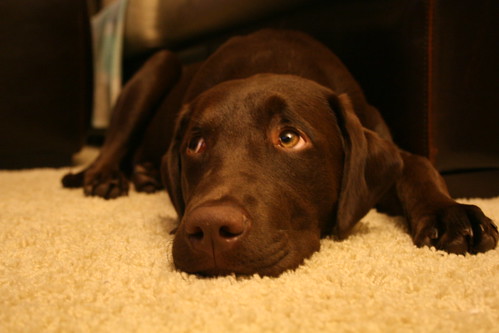
Chocolate Lab Chewer
Question:
We adopted a black lab 3 1/2 years ago. She is wonderful and only chewed the dinning room rug when she was a puppy. She is fully house broken and doesn't chew. She had full run of the house when we are not home. Well we just adopted a 2 1/2 year old chocolate lab. The first three weeks she was a lot like her older sister. No problems. Went to work, came home there was Nelly sleeping. Well now that she is comfortable we are realizing she has some separation issues. We might come home to destroyed kids toys and dog toys (stuffed). The other day we came home to bm & urine accidents. Another day pulled items off the counter. So I put her in a crate today (1st day of crate) came home to destroyed crate floor. I left her with a nylabone, a raw hide and a kong. I am going to try the banana/kibble. When we are home she is layed back and very relaxed. I'd like her to eventually be free in the house. Any suggestions for ''busy" toys and do you think that will help.

Answer:
Getting a Lab to be free in the house can be tricky as one solution does not fit all. If this were my Lab, I would do the following:

1) Take the dog for long walks several times a day. (2 is good – 3 is better) Just make sure it is always around the same time each and every day so you pup gets on schedule and knows when some much needed exercise is coming.

2) Have at least 1 major outside play sessions per day to tire the pup out.

3) Stimulate the brain when home by playing games of Find It. Labs are hunters and retrievers – let them use their skill on something other than your personal belongings and furniture.

4) Work on obedience training to not only curb bad habits but also build a relationship between you and the pup. The animal hierarchy needs to be addressed and you need to be in alpha control.

5) Use a wire crate and remove the bottom when crating or crate training your dog. Also use a frozen banana kibble treat in the crate when you leave. Note that you should use a black Kong for more aggressive chewers as these seem to hold up the best. Also, make sure you remove the pup’s dog collar to prevent her from getting it caught on the crate – which can lead to strangulation.

Training a new pup is a long process and consistent training is crucial – no matter what the age of your canine companion. You must remain diligent in your pack role and training at all times.

In our own house, nothing is free. Treats are given for good behavior and tricks. Meals are given only after they have shown us respect by sitting by their bowl and waiting for our command before eating. This type of hierarchy as allowed us to set boundaries. Each brat has only chewed one thing each in their entire lives… Dakota was her bed when she was a few months old and I left on business… Cheyenne was an extension cord when she was a few months old and we just put up the Christmas tree (she did not know it was off limits yet). Today they have full run of the house and nothing has ever been chewed and they stay off each and every piece of furniture!

Don’t discourage as it will take time but most certainly can be done! :)

Labels: ,

Wednesday, April 15, 2009

Switching to Adult Dog Food

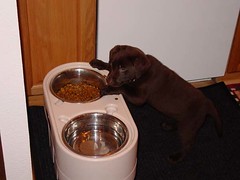
Puppy Eating Big Bowl of Dog Food
Question:
Our chocolate lab brothers are 12 months old. Do we continue with puppy food or begin to give them adult food? Do you think they are full grown or do they continue to grow until age 2? We neutered them at 8 months.


Answer:
Our breeder and veterinarian have both recommended that Labrador Retrievers be switched to adult food around the 1-year mark. They will continue to grow until age 2 but puppy food is too rich during their 2nd year of life. This is due to the growth phases in this particular breed and at age 1 they need less calories and a more stable and well-rounded diet.

Make sure that you gradually switch their food as to not upset their stomachs. To learn more, please read our Labrador Retriever Feeding Guide.

Labels: ,

Friday, April 10, 2009

5 Reasons Dogs Won't Eat

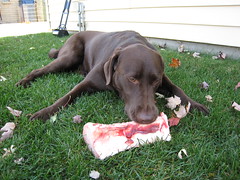
Cheyenne eating a bone
Question:
My 9 month old female chocolate Lab has stopped eating for the pass 2 days. I don't know what to do or why she has stopped eating. Can you please [help] me?

Answer:
Every so often dogs will decide to stop eating for a variety of reasons.

1. The food bowl is not clean. If there is any bacteria or subtle scents coming from the bowl, then dogs may refuse to use that bowl. It is recommended that you use a stainless steel bowl as this is the most sanitary and is not porous.

2. The food is bad. Is it a new bag of food or a new brand of dog food? If so, your dog may not like it. If it is a new bag of dog food but the same brand, then it is recommended that you pick up a smaller new bag of that same dog food to see if the originating bag is contaminated with something. If it is a new brand of dog food then your pup may just not like the food at all.

3. The pup is pregnant or in heat. Although you have a young pup, is there a chance she may be pregnant? Pups in heat or pregnant can go through times of refusing to eat - which is normal for a few days here and there.

4. There is a bowel obstruction or digestive disorder. Is your pup still eliminating? Does your dog still take other food such as treats or human snacks? Is it vomiting? If your dog is even refusing the most delicious of treats and/or not eliminating, then there may be a bowel obstruction or it may have a digestive disorder. In this case, it is recommended that you get the pup to a vet ASAP.

5. The pup is just being stubborn. Have you brought a new person or animal into the home recently? Have you changed anything about the pup? Has the pup been through any trauma lately? If the answer to any of these is yes, then your pup may be going through emotional distress as it is unsure of its environment. Changes in lifestyle or routine can easily disturb a pup and cause it not to eat.

In the end, you know your pup the best and can best determine if your pup has a serious problem or not. My overall recommendation would be to call your vet if you notice any behavioral or physical changes in your pup. The veterinarian's office will give you free health advice over the phone and provide a more specific list of recommendations based on their past experience with your dog. If your dog has gone more than a couple of days without food, I would definitely seek professional assistance.

Best of luck and please let us know how it goes!

Labels: , ,

Wednesday, April 08, 2009

Hesitant to Alter Pup

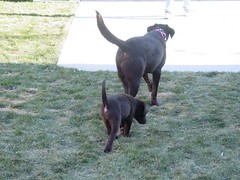
Chocolate Pups: Dakota leading Cheyenne
Question:

Have you neutured them? Their coat is beautiful and shinny and they are not overweight. My mom is hesitant is neutering our female pup.

Many thanks.


Answer:

Yes, both of my Labrador Retrievers were spayed at the age of 6 months old. This did not have any negative effect on them at all. In all honesty, it is wise to neuter or spay dogs as it reduces the risk of reproductive system cancers and other diseases linked to the reproductive organs. As you can see in our dogs, their being altered in no way made them unhealthy or fat.

We had chosen not to breed our dogs because the risk of them being taken early from us was too great of a risk. The Lab Brats are our family and their health is the most important thing to us.

I highly recommend you read this article About Spaying and Neutering Your Labrador Retriever.

It is a personal decision that every responsible pet own must make. However, if your mom is not going to breed your pup because she wants to breed the pup responsibly (to better the line of the Labrador Retriever) then she is best to speak to your local veterinarian in regards to pros and cons of altering your pup.

Labels: ,

Wednesday, March 25, 2009

New Puppy Questions

Chocolate Puppy Stealing Food: Cheyenne
Question:
Hi - my husband and I adore your blog with all of its videos, info and 100s of pics on flickr. Our Lab puppy will be ready to come home in two weeks and I have a few questions for you.

1. What is the best puppy food?
2. Did you crate train and if so, what size crate did you buy?

We are trying to prepare as much as possible before Kirby arrives. My husband and I grew up with dogs but never raised a puppy. Any suggestions will be greatly appreciated. This is all so very exciting. We look forward to hearing from you.


Answer:
First, major congrats on the new puppy. This is definitely an exciting time and applaud how responsible you are to do research online before even bringing your new puppy home!

To answer your questions:

1) What is the best puppy food? Well, people who read my blog know that I am head over heels in love with Eagle Pack Holistic dry dog food. They have a very well balanced and high quality Eagle Pack Holistic Select® Large & Giant Breed Puppy Formula that I would definitely recommend for the first 6 months to a year. If you find that your puppy has chicken allergies (which can happen in Labrador Retrievers), then I would recommend what we use: Eagle Pack Holistic Select® Anchovy, Sardine & Salmon Meal Formula. Make sure though that you gradually switch the puppy from the food your breeder used to any new food you decide to go with. For more information, check out our article on Feeding Guidelines for Labrador Retrievers.

2) Did you crate train and if so, what size crate did you buy? When I was younger, I used to think crate training was barbaric. However, I have to admit that I now *love* crate training and will vouch that this is the reason our Labs were housebroken so fast and are so well trained/behaved. Our recommended crate is the Midwest Life Stages dog crate. We have the Life Stages - Single Door 42" as this is the perfect size to grow with your large breed Lab. Our main reason for choosing this crate: folds easily for moving, has a divider panel that allows the crate to grow with the pup, has a plastic pan on the bottom for easy clean up (especially during housebreaking), chew resistant metal (Labs can easily chew plastic crates) and loads of openness for airflow and to be part of what is going on around them. To help, check out these articles on Crate Training Your Labrador and Housebreaking Your Pup.

Best of luck and be sure to send us pictures of the new pup!

Labels: ,

Wednesday, March 04, 2009

Email the Lab Brats!

Email us for questions on Labrador Retrievers
After much debate, I have finally decided to open my brain to the rest of the world. Luckily, this is a virtual surgery for I need every last brain cell to remain sane with two highly energetic Labrador Retrievers and to remain happily married as well.

(Did you notice the dogs came before the husband? *laugh*)

Comments are great and I totally encourage posting comments to my blog posts. However, many people have been wanting a more personal communication form to ask questions about dog health, life, breed specifics, training or to just send some puppy love. Your wish is my command!

For our special virtual doggy family, you can now Email the Lab Brats family! Just click on the cool looking link in our sidebar to Contact Us and you will be whisked over to an easy to use email form where you can ask questions, leave feedback or send me pictures of your beloved canine companions.

So send us your dog mail and who knows, you or your dog related topic may just make our next blog post! *wink*


Special Thanks
Chocolate Lab "dog mail" graphic provided by Art By Angi.

Labels: ,

Monday, October 27, 2008

Hidden Bananas


Tough times call for tough action! The dogs must have their medication but Dakota is too stubborn to take it without a little enticing.

Normally we would use processed cheese slices to wrap up her pills but with the cost of food continuing to rise with no end in sight, purchasing sub-par processed cheese just to confuse the Lab Brats is costing us money we shouldn't have to be spending.

After some thought, I decided that the best way to still trick her into swallowing her pill while saving a few extra bucks is to share my own food. You see, every day I eat a good amount of fruit and the Labs LOVE fruit! What better fruit to hide a pill in then a banana!

So, I will tear off two small bits of my banana and shove their pill in each piece. Dakota doesn't even bother chewing bananas (yes, she can swallow a whole one if we let her) so she never even notices the pill is inside. I share a small bit of my banana, don't have to spend any extra money on unnecessary items, and the Labradors get their daily medication.

Ha! You think you are only getting a great treat when you are actually taking your medication. Take that Dakota!!

Labels: ,

Monday, August 11, 2008

Stomach Blemishes

Chocolate Lab Belly
Question:
I have a 9 month old yellow lab and I have noticed what looks like blackheads on her stomach area. They extend all the way from her top nipples down to her girl parts. I have looked everywhere on the internet and it all says canine acne occurs on the lips and chin of dogs. I an wondering if anyone has ever noticed it on their dogs abdomen? Or is this something i should consider taking her to the vet for.

Answer:
Acne on a dog is only a concern for a veterinarian when the area becomes infected or causes the pup to be uncomfortable. Acne on the stomach area can be caused by genetics, cleanliness, or an allergic reaction to something. Since they are only blackheads and are not red, inflamed, or causing her to lick/scratch them, then I would recommend that you use some oatmeal or hypo-allergic dog shampoo and warm water to clean the area daily. This is the best way to keep the area clean while not subjecting the skin harsh chemicals.

If it were one of my pups, I would also wash the dog's bedding with Nature's Miracle and a allergen free detergent to help should it be an allergic reaction to something it is laying or sleeping on.

If these recommendations do not rid your dog of the blackhead acne on the under belly area and you are still concerned, please call your veterinarian to ask for advice. They should be able to give you recommendations over the phone for free and not request that you come in for a visit.

Labels: ,

Monday, July 21, 2008

Cheesy Medicine Tip

Giving Dog Pill Cartoon
We get so many people that write ask - telling us how much they love our "tricks" to getting our Labs to do what we want. So, here is another one that works for us.

Every morning the Lab Brats are given a Proin 50 pill to help with bladder problems (caused by spaying sometimes). The problem is that Cheyenne will eagerly take the beef smelling pill but Dakota knows better - she knows it is medicine.

Our trick is simple. Every week when we go to the grocery store, we buy the no-frills processed sliced cheese for the dogs. A pack of 16 slices lasts 32 days for the 2 dogs.

We simply divide the slice into 4 pieces and wrap a pill up in a quarter of the original slice. Of course, with Dakota being so smart and all, we have to make sure to wrap it entirely in the cheese or she will find some way to get the cheese and spit out the pill. (Kind of like those people that can tie a cherry stem in their mouth)

The great thing is that they look forward to it and Dakota even drools all over the floor as she waits for me to wrap her pill in the cheese. Just call out "Who wants medicine?" in our house and the dogs come flying. No need for me to put my hand into the vortex formally known as Dakota's huge throat. Just a nice and pleasant way to give our Labradors their medication and they love it!

Labels: ,

Friday, July 04, 2008

Dog Tip: Applying Flea & Tick Prevention


The Lab Brats don't particularly care for the 2nd of every month. They know when we go into their special draw in the kitchen that is means only one thing: time to put that nasty smelling liquid on the back of their necks.

Our house uses Frontline Plus because of the climate we live in and the fact that Labrador Retrievers are double-coated dogs. The trick is to get the application on their skin and not all over one's hands nor the dog's fur. For that, we have a trick up our sleeves.

When the pups were small, we purchased a flea and tick comb to check them regularly for any nasty bugs. Of course, the comb became obsolete so we now use it to apply the Frontline to their skin. As the comb makes a clean part down into even the under layer of fur, the Lab Brats Daddy is able to apply it without any assistance. One hand uses the tip of the comb to make a part between the shoulder blades and then just tilts the comb 45 degrees to the side to show the dog's skin. With the other hand he applies some of the liquid directly to the skin and then makes a couple of more parts in the fur with the comb until the applicator is empty.

Of course, we apply the medication at night so that we don't run a higher risk of them rubbing it off on furniture or our petting them in that spot. However, the comb is the most efficient (and less stressful) method of applying flea and tick preventative that we have found and the Lab Brats love how it only takes a few seconds to apply.

Labels: ,

Wednesday, May 07, 2008

Seeking Lab Advice?

Labrador Retriever Dogs Chat Board
Some of you may have noticed that the link to "Lab Advice" in the right sidebar is now gone. It is not that I don't want to help other Labrador Retriever dog owners but rather the amount of outpouring I have received in response to the advice mailbox.

So many Lab dog owners and lovers have written me; seeking advice based on my own personal experience. The thing is that I really don't have enough time in my schedule there days to answer the flood of emails. That is why I will no longer be giving one-on-one Lab advice to other dog owners.

However, I will not leave you high and dry. I know how important it is for dog owners to become familiar with this specific dog breed and have a place to seek advice in times of need. For those needing answers to specific Lab health, training, and breed questions, I invite you to join the Labrador Retriever Dogs Chat Board. I have been a member of this specific board since a few weeks after Dakota came home - that is over 3 years ago!

There is a great wealth of information on this message board and the forums are filled with the knowledge and expertise of not only other Labrador Retriever owners but people in the veterinarian field, dog breeders, and dog training professionals.

So there is no reason to be discouraged. The Lab Brats blog will still bring you loads of funny stories, articles, and the daily life of Dakota & Cheyenne - two impossible chocolate Labs with a quest to drive this Lab mommy insane!

Labels:

Wednesday, April 30, 2008

Labrador Limp

Yellow Labrador with Ball
Question:
My 9 month old puppy recently developed a limp about two months ago. She never seemed to be in any pain, always up for playing and running around. However, we were getting worried so we took her to the vet last week for x-rays. She told us that she limps to favour her left front leg, however the x-rays showed us healthy shoulders and elbows. Its been two days since the x-rays and she limps worse, hardly putting any weight on her foot - however the vet said this is normal and that the leg would be sore for a couple of days because of the x-rays. Is this limp just growing pains? Nothing to worry about?
Signed,
Ashley

Answer:
Ahh - we went through this with Cheyenne. I tell you - that dog can go through anything and never let on that she is in pain or uncomfortable! Play is play: no matter if they have a limp or not!

This problem can easily resolve on its own as it may just be a sprain. When our Lab was displaying this, it was her front elbow and the vet thought that she could have OCD. Now OCD can be corrected but even with her the problem went away on its own after following some simple at home care steps our veterinarian gave us:

- Crate rest for 23 out of the 24 hours in a day.
- Allowed out of the crate for bathroom (potty) runs.
- Must be taken outside to go to the bathroom on a leash only.
- No doggie daycare.
- No dog parks.
- No jumping and running with her sister, Dakota.
- Steroid/ anti-inflammatory medication once a day. (Metacam)
- Joint/hip supplements twice a day. (recommended)

This went on for 3 weeks before she was all better and I highly recommend it. If you don't have the anti-inflammatory medication, you can request some from your vet or just do without. Today she is still on the joint/hip supplement (Cosequin DS) but doesn't show any signs of ever having a problem.

Our Labbie prayers are with you!

Labels: ,

Monday, April 28, 2008

Leash Pulling Puppy

Yellow Lab Puppy
Question:
Our yellow lab is three and a half months old and progressing wonderfully! She's extremely friendly, very eager to learn new tricks, and very active (exactly what we wanted in a lab!). We do have one small problem. She pulls a lot on the leash. Especially if there is someone/some dog that she feels that she needs to see. I almost half wish she were less friendly so she'd be less eager to go see other things. Right now it's fine, because I can handle her and pull her back. When she is a full grown dog, this will be not so okay. We are trying to teach her to stay next to us by using treats, but it doesn't seem to be working so far. I've gotten her to sit instead of pull, but then she will not move until the person/dog she wants to see is completely out of her line of vision and has been for thirty seconds. This can be a very big hassle. Do you have any advice for training her not to pull?

-Jessica


Answer:
Leash training such young pups is much different then training adult or larger Labradors. In your case, I will tell you what I did for Dakota when she was that young (she doesn't pull very much anymore).

1) Before starting your walk, make sure the collar is snug but not too tight. The collar should never come up to the dog's ears or over them.

2) When walking, keep your pup next to your side. If you need to wrap up the leash in your hand then do so. The pup should never be in front of you.

3) If the pup starts to pull in any direction, just give a quick tug on the leash and change your entire direction. If, for example, you are walking west, give a quick tug and start walking east. Do not drag the pup but just give it notice that you changed direction and it should follow you.

4) When people are coming towards you, move to one side of the walkway and put your pup in the sit position. The pup should be a good 2-3 feet from where the person is going to walk through. If she gets up, put her rear right back down. Once the person as fully passed, call her name and say "ok" while taking a step out with the leg closest to her and continue your walk.

These 4 points should get you started. Yes, you may look a little foolish with step 3 but it works in the end. The pup has no clue what you are going to do next so it will start to look at you for direction rather then everyone around you. Just remember to stay persistent and consistent with the training no matter who is walking her. At that age, I would even start doing this in your own yard with treats but leave the treats at home when walking on the streets as you want her to obey you - not the cookie.

Best of Labbie luck!

Labels: ,

Wednesday, April 23, 2008

11-Year Old Lab OCD

Chocolate Lab Licking Lips
Question:
my 11yr old yellow lab, Stoli, is OCD. He is licking his front legs to an out of control problem. He has had to be confined to the cone head device to prevent his licking himself to very bad open wounds and the minute it ever comes off his head to go to walk etc. I can hardly control my very obidient dog to get him to refrain from just going full force at those sores. The cone reduces him to almost 23 hrs of sleep/depression per day. It breaks my heart but bandage only attracts him. we have been through several skin treatments and if they help the sores will be right back upon removal of cone. i have even considered having to put him down rather that see him so demoralized by his cone restraint which seems to be my only way to stop that damn licking himself to death! i hope you may have some advice or perhaps your thoughts about such a final decision as euthanasia.
Greg


Answer:
Medical problems such as obsessive licking are usually difficult to handle for dog owners because it is nerve-wrecking and makes you worrisome. However, if your Stoli where one of my Lab Brats, here is what I would do:

1. Check your dog food. A good portion of skin allergies that cause such behaviors is caused by an allergic reaction to the dog food. Sure, your pup may have been on the same dog food for years but just like humans, dog's bodies change. Labrador are especially prone to food allergies so I would recommend slowly changing out the current dog food you are using with a dog food that is of high quality and does not contain any chicken in it. Now I like the Holistic Select® Senior Care® Formula but that contains chicken meal as the first ingredient so I would put my dog on the Holistic Select® Anchovy, Sardine & Salmon Meal Formula. Actually both of my Lab Brats are currently on the latter because they have very bad skin reactions to chicken and will scratch themselves to death if they were eating a chicken-based diet. For further information on this topic, please read this article: Labs and Dog Foods. Remember that it could take a few weeks for you to see any results from changing the food as new skin needs to grow.

2. Bandage any sores that currently exist and spray the outside with Bitter Apple spray. You can pick up the spray at any pet store and a small amount should work on top of the bandage. Once he gets his tongue on it, it will taste horrible and should stop him from licking it any further. Of course, speak with your vet on how to properly clean and bandage the current wounds first before doing so. Many veterinarian offices will offer free advice over the phone so there is no need to bring your pup in.

3. Wash your Lab's bedding in hot water with allergen free soaps such as All Free. You will also want to add some Nature's Miracle into the wash to get out any dog stains and odors. It should be hot water and the his bedding should be washed weekly.

4. An oatmeal bath does wonders! When you can tell his skin is very dry and he is uncomfortable, give him a light bath with Oatmeal dog shampoo. Make sure there are no perfumes or additives in the shampoo that may upset his skin. Normally you can find them where the puppy shampoo is located.

5. Make sure he has plenty of clean water throughout the day. Just like humans, water replenishes the moisture in the skin of dogs. If he doesn't drink a lot of water, just drop a couple of bits of kibble in the water and he will drink up half the bowl just trying to fish them out.

These suggestions are what I would personally start with if it were either my Dakota or Cheyenne having this problem. From all my research and everything I have heard other Lab owners say, most skin allergies can be combated with dietary and environmental changes. Please don't give up hope on Stoli and please keep us up to date on how he is doing.

Lab smiles,
Shannon

Labels: ,

Monday, April 21, 2008

Signaling Potty Time

Black Labrador Retriever Puppy
Question:
Hello, I was just wondering when puppies decide to let you know when they want to go outside. Our puppy is now 11 weeks old and he does not tell us by a whine or a bark. If we are not watching him we will not know and then he has an accident.
If you have any advice on traing him to let us know that would be great.
Thanks again
Chantale


Answer:
Each puppy has it's own way to let you know that it needs to go outside. The way that works best for you, your pup, and your family should be trained so that no one mistakes the signal. In order to train your new pup, before you bring it outside to do its deed, have a bell or something near the door that makes noise and hit its paw against it. Then give it praise and take it out to go to the bathroom.

In our house, Cheyenne would never tell us when she had to go potty and instead she would just stand by the backdoor. If we did not notice her, she would find somewhere to go in the house after a while. That was our sign that we needed to keep a better eye on her to see when she stood by the backdoor. It worked perfectly and as she got older, she started to let out a single high pitch bark by the backdoor to let us know she needed out. Dakota, on the other hand, will paw the backdoor or hit the spring doorstopper to signal her needs.

It will take time and if you want him to signal in a certain fashion, put something that makes noise by the backdoor and train him to use it.

Best of luck!

Labels: ,

Thursday, April 17, 2008

Correctly Intoducing a 2nd Lab

Yellow and Chocolate Labrador Retrievers
Question:
I am a fan of Lab Brats being a chocolate lab owner myself and have found your advice helpful. We are thinking of adding a 1 year old yellow neutered male to our household. Any advice on how best to make this work. Our chocolate lab is a neutered female about 6.5 years old and seems to be pretty dominate around other dogs--not aggressive just doesn't want to play. I know this one year old is playful and will need a lot of work with recall and help getting rid of his boundless energy. We live out in the country and will have a fenced in yard in place by the time we bring him home. Any advice on how to introduce him to the household would be appreciated.

Thank you in advance.
Paulina


Answer:
My breeder warned me - "One Lab is like one tornado and two is like ten!" Honestly though, I love having two Labrador Retrievers and couldn't picture life without either of the Lab Brats. However, bringing home a second dog can be tricky but wonderful if done correctly.

Whenever you bring another dog into your family pack, you need to help the dogs (and family) understand where the dog fits in. If possible, I recommend a few meetings of the two dogs off site before bringing them into closer contact. If you are rescuing, the Lab rescue's foster family may provide you with an opportunity to have the dogs meet at a local dog park or some other neutral area where they can get to know each other. This neutral field will take away the "property" dominance and help the dogs get to know each other better.

When you are ready to bring home the next dog, have them meet outside in some neutral area of the property. For most people, this would be their front yard as the dogs spend more time in the backyard. Let them get to know each other for hours if you can before even attempting to move them into the house.

Once in the house, have certain areas blocked off to the new dog that your dog has major claims over. If there is a certain area is sleeps, block that off from the new dog and offer that area to be available to the existing dog at all times. For us, we brought home a puppy and had a baby gate in our hallway blocking off the bedrooms. When Dakota had enough of Cheyenne puppy biting all over her, she could easily make it over the fence to her sanctuary (and her bed). Cheyenne also had her crate in the living room and Dakota was not allowed to enter it. The crate was new and as far as Dakota was concerned, it came with the new puppy. Dakota would eagerly flee to get sanctuary as we never pushed the puppy on her and let them develop their own bonds at their own times.

On top of this, we also continued to feed Dakota first, give treats first, pet first, and let outside first. Cheyenne was to stay away from her while eating and was not allowed to demand our attention when we were giving it to Dakota.

Now it would take the Jaws of Life to separate the Lab Brats. The have their own crates side-by-side but when outside of them, they cuddle together on the floor, clean each other's ears (eww!), and play together as though they have always been. It takes time and if properly done, it can be the best doggy relationship ever!

Best of luck!

Labels: ,

Thursday, April 10, 2008

Velcro Dog

Chocolate Labs waiting at window
Question:
First, I just wanted to say that I love your blog and read it every day, usually with my own little chocolate lab brat lying on my feet.

I have a question about separation anxiety. My boyfriend and I have a 5-month-old chocolate lab named Boomer. He's very sweet and smart and we love him dearly. A couple days ago, Boyfriend had to go out of town for work and he'll be home in another couple of days. When he left, Boomer seemed to just mope around the house for an entire day. The second day, I tried to distract him by taking him walking on a nearby nature trail and setting up a playdate for him with one of my friends' dogs. This seemed to cheer him up a bit, but he's still being extra clingy to me and was very vocal last night about not wanting to go into his crate when I went to have dinner out.

This wouldn't concern me that much as Boyfriend is coming back in two days, except that I have to leave to work in a different city over the summer. It's about two hours away and I'm subleasing an apartment there for the summer, but I will be home on weekends. I was wondering if there's any way to sort of prepare Boomer for this, as I don't want him to be mopey all summer while I'm gone.

Thanks!
-Sarah


Answer:
Separation anxiety and Labrador Retrievers is very common as they are "people dogs". All they want is to be around people and please their owners.

To prepare for those long periods of absence, I would recommend that you begin to leave the house for long periods of time now. Leave your boyfriend in charge of Boomer and go off to a day out with friends. Show Boomer that is alright for you to be gone for long periods of time because you always come home in the end. And when you come home, bring Boomer something special such as a new treats or toy to show him that the waiting is well worth it. When you return home and act like it is a party just to see Boomer, he will begin to associate your leaving and returning with something good rather then dreading the day his mommy leaves.

Good luck and let us know how it goes!

Labels: ,

Tuesday, April 08, 2008

Curbing Ball OCD

Chocolate Lab Puppy
Question:
After read a few of your posts, I’m thinking we have identical dogs. Here’s mine.

She is currently only 10 months. I’m still trying to figure out a way for her to leave the ball alone. =) I came upon your site because I’m trying to “curb my lab’s ball OCD.” When we’re at a dog park, she won’t look at anything other than the ball. When we hide the ball she likes to take other dog’s balls. Any suggestions would be very much appreciated.

Alex


Answer:
Toy obsession is something we live with on a daily basis in our own home and it is a long training process. The first thing that needs to be done with your pup is to teach her the "leave it" command. This is a crucial training step with Labrador Retrievers as they love to put almost anything in their mouths. This is best taught while on lead and during walks as you can give a quick tug on the lead away from the offending object while saying "leave it" at the same time. When she leaves the thing alone, give her loads of praise. If she does not, remove it from her mouth, put it back on the ground, and when she starts to get close to it again tug on the lead and say "leave it".

Another way of doing the "leave it" command is with her favorite treat. You get your dog to sit in front of you, put the treat in your hand, and close your hand. Put your fist in front of her but a few inches away. When she goes to sniff, tell her "leave it" and keep your fist close while repeating the command until she finally loses interest and leaves it. Then give her the treat. Our Lab Brats have gotten so good at this that we can put food down in front of them (even on their own paw when laying down) and tell them to leave it. They won't touch it until we say "ok" and point to the food.

What does this have to do with ball obsession? Easy! If you view our video from Dakota's birthday, you can see that we are now able to place toys in front of them and get them to leave them alone. When we are at parks and either of our pups try to go for other dogs' toys, we give them a stern "leave it" or "not yours" command and they don't touch it. No matter how much Dakota may want that ball or stuffed duck, she will not touch it until we give her the "ok".

Just remember that Labs want and need training so spend at least 15-30 minutes a day performing these training exercises and in no time, you will be able to "curb" your lab's ball OCD to a point where it is no longer a headache.

Labels: ,

Wednesday, April 02, 2008

Sleep Walking Dog?

Dakota: Chocolate Pup Sleeping
Question:
Hi Shannon - I've been enjoying your Lab Brats blog and reading about Dakota and Cheyenne. I also appreciate your links to helpful lab information. I have a 3 year chocolate lab named Gracie. Several times last year she fell out of bed in the middle of the night (yes, she does sleep with me). Occasionally, this year, she will jump off the bed in the middle of the night. When I turn on the light to see what she is doing, she is just standing in the middle of the room. I'll call her name and she'll look at me, blink a few times and then crawl back in bed. I wonder if she is sleep walking. Do you know if dogs sleep walk?

Answer:
Gracie may be jumping out of the bed for fear of falling out of it. For example, when I make any movements in my recliner, Cheyenne will jump up no matter where she may be lying. This is because the recliner had come down on her paw a couple of times when she was younger. To make sure it doesn't happen again, she is quick to get out of the way - even if we aren't bringing the foot of the recliner down.

It seems to me that your Gracie may be doing the same thing. You may move in a certain way while in bed that makes her believe she is going to fall out or be pushed out of the bed. Instead of risking it, she gets out of the way - just like our Cheyenne.

As for sleep walking... it seems the common consensus from all my resources that dogs do not really sleep walk. Is it possible? Sure, anything is possible. However, it is very unlikely. *smile*

Maybe Gracie needs her own bed on the floor next to yours in order to feel close to you but safe at the same time. *wink*

Labels: ,

Tuesday, April 01, 2008

Labrador Bonding

Two Black Lab Pups
Question:
I just brought home an eight week old lab pup. She is wonderful, but I have been hearing that I should limit the amount of time she spends with my older lab so that her primary bond will be to me and not our older dog. Whille others have said as long as I have time alone with the puppy she will bond with me. How much time do you recommend your pup spends with your older dog?
Thanks!
Shauna


Answer:
First, congrats on the new puppy! How exciting it must be to have an older Lab and a Lab puppy!

The bond between dogs is strongest within the same litter and tends to funnel out from there. So, if you were to bring home two siblings from the same litter, it would not be wise to let them spend a great deal of time alone together because they will then set an alpha role between them and it would be more difficult for the human to gain that role. However, you have two Labs that are not from the same litter, were not raised around each other, and have a good difference in age. Therefore, there is no reason to limit the amount of time she spends with your older Lab.

In order to help you maintain your alpha role and allow for the new pup to properly bond with you, here is what worked for us and what I highly recommend:

1. Each Lab should have its own bed, crate, food, and water bowls. This way they are not sharing and are able to be individual dogs in their own defined space.

2. If they are being crate trained, make sure each dog has its own crate. It is fine to have them next to each other but they need their own "den".

3. Treat and pet in succession of the hierarchy in your "pack". Although you may think the older dog should be the alpha out of the two, remember that you are alpha and they will let you know which one of the two ranks higher then the other in the coming months.

4. Do things separate with the dogs as well as together. Bringing home a new pup can make the older dog get confused about its place in the pack. Allow the older dog (as well as the pup) one-on-one time. If you have another person in your house, this is a great time for one of you to take one dog for a walk while the other one stays home and plays - then change up the roles from time to time.

5. If you are going to bring either of your dogs to training, make sure they are in separate classes. Otherwise, the dogs will concentrate on each other and not on the training. (Trust me on this. This was a mistake we made and it wasted our money and time having them both in the same class.)

The bond between your pups can be one of the most wonderful things to witness if done properly. Both of the Lab Brats are so loving to each other that if one even cries in her sleep, the other one will wake up out of a sound sleep, go over to the other, and nuzzle her to wake her up and make sure she is ok. Then she will walk away and go back to where she was. They also clean each other's ears, play lovingly, and so on. However, it was difficult to separate them in the beginning because we didn't do enough alone time. I am happy to report that it is different today. Although one will look for the other when she is gone from the house or from site, there are no tantrums or problems.

Today they do almost everything together... it is just getting through the beginning stages to ensure that they know the alpha role lay with you and not the other dog.

Hang in there and enjoy the puppy age while you can! They grow up so fast and before you know it, you have an 84lbs baby that loves to use you as a napkin after she is done drinking her water! *laugh*

Lab smiles,
Shannon

PS - I would read this article on Labrador Retriever Sibling Rivalry should you every need it in the future.

Labels: ,