My blog has moved!

You should be automatically redirected in 6 seconds. If not, visit
http://dogblog.8pawsup.com
and update your bookmarks.

Wednesday, April 22, 2009

5 Ways to Help Curb a Chewing Dog

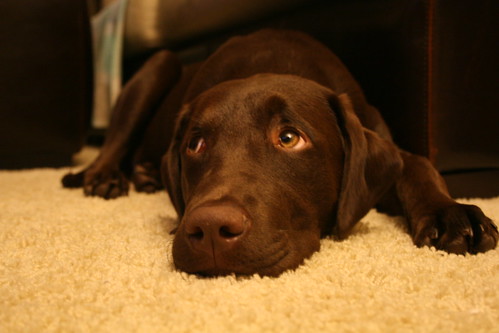
Chocolate Lab Chewer
Question:
We adopted a black lab 3 1/2 years ago. She is wonderful and only chewed the dinning room rug when she was a puppy. She is fully house broken and doesn't chew. She had full run of the house when we are not home. Well we just adopted a 2 1/2 year old chocolate lab. The first three weeks she was a lot like her older sister. No problems. Went to work, came home there was Nelly sleeping. Well now that she is comfortable we are realizing she has some separation issues. We might come home to destroyed kids toys and dog toys (stuffed). The other day we came home to bm & urine accidents. Another day pulled items off the counter. So I put her in a crate today (1st day of crate) came home to destroyed crate floor. I left her with a nylabone, a raw hide and a kong. I am going to try the banana/kibble. When we are home she is layed back and very relaxed. I'd like her to eventually be free in the house. Any suggestions for ''busy" toys and do you think that will help.

Answer:
Getting a Lab to be free in the house can be tricky as one solution does not fit all. If this were my Lab, I would do the following:

1) Take the dog for long walks several times a day. (2 is good – 3 is better) Just make sure it is always around the same time each and every day so you pup gets on schedule and knows when some much needed exercise is coming.

2) Have at least 1 major outside play sessions per day to tire the pup out.

3) Stimulate the brain when home by playing games of Find It. Labs are hunters and retrievers – let them use their skill on something other than your personal belongings and furniture.

4) Work on obedience training to not only curb bad habits but also build a relationship between you and the pup. The animal hierarchy needs to be addressed and you need to be in alpha control.

5) Use a wire crate and remove the bottom when crating or crate training your dog. Also use a frozen banana kibble treat in the crate when you leave. Note that you should use a black Kong for more aggressive chewers as these seem to hold up the best. Also, make sure you remove the pup’s dog collar to prevent her from getting it caught on the crate – which can lead to strangulation.

Training a new pup is a long process and consistent training is crucial – no matter what the age of your canine companion. You must remain diligent in your pack role and training at all times.

In our own house, nothing is free. Treats are given for good behavior and tricks. Meals are given only after they have shown us respect by sitting by their bowl and waiting for our command before eating. This type of hierarchy as allowed us to set boundaries. Each brat has only chewed one thing each in their entire lives… Dakota was her bed when she was a few months old and I left on business… Cheyenne was an extension cord when she was a few months old and we just put up the Christmas tree (she did not know it was off limits yet). Today they have full run of the house and nothing has ever been chewed and they stay off each and every piece of furniture!

Don’t discourage as it will take time but most certainly can be done! :)

Labels: ,

Monday, April 20, 2009

On Puppy Socialization

Criket Hollow Black Lab Pup
All too often the Lab Brats receive such compliments as: "They are so well behaved." "What trainer did you use?" "They are just so sociable and calm." Well, yes, yes and yes again. They may be called the Lab Brats but that is due to their goofy nature rather than any social flaw. They are calm, stable, gentle, friendly, submissive, well-behaved and extremely respectful.

So, what caused them to become this way?

Our breeder enlightened us to the important of puppy socialization. That is to say that from a very early age (shortly after birth through today), our pups have been introduced to a variety of different people, places and things that may make other pups run with their tails between their legs if not introduced properly.

The AKC had recently released a "must read" article entitled "The Importance of Puppy Socialization" by Arliss Paddock, in which the author walks the readers through an brief introduction of newborn social behaviors, windows of opportunity, strategies, "100 people by 12 weeks", and a standard of care.

I found myself nodding along with the article and wishing that more Labrador Retriever dog owners would take the time to read it - especially during the early stages of their pup's life. The article itself mirrors the process by which Cricket Hollow Farm Labradors (breeder of the Lab Brats) own breeder follows on each and every puppy. This particular breeder has outlined the following information on their puppy page:

"We are careful about where our precious little ones are going. We do our utmost to ensure the babies will be all they can be, we start them off right by using the BioSensor method of neurological stimulation. We also socialize our puppies extensively to ensure they will be happy, healthy additions to their new families. We take special care in deciding which puppy goes where by use of extensive puppy aptitude testing."

So before the Lab Brats even came home, at 8 weeks old each, they had extensive socialization. Once they became part of our pack, we continued that socialization slowly but progressively.

That, coupled with daily training, bonding, and exercise, has produced highly social, well-behaved, thoughtful, intelligent and awesome family canine companions that continue to make us proud and add more joy to our lives every day.

Labels:

Wednesday, March 18, 2009

Removing Crates and Turning Heads

Yellow Lab Cody taking a bath
Question:
I enjoy your stories and it is nice to connect with some one who lives the "expressions, complaints, happiness, loyalty, and character of a lab". Our sweet lab is from Cricket Hollow Farms. Chris Anderson is awesome. Our Lab, Cody uses a large crate. We never close him in it, he uses it to retreat to and sleep in at night. I would like to graduate him not using the crate any longer. He is now 19 months. He very trustworthy when we are gone or at night. Is the crate something he should have the rest of his life because of the den like atmosphere? Should I not remove it? Also, when you doctor up your labs such as apply creams or ear solutions, does your lab look away from you? My Cody will turn his head from me and not look at me the entire time I am doctoring something on him. I was curious about this behavior.


Answer:
I love hearing from other Cricket Hollow Farm Labrador Retrievers families! Chris is an awesome woman and the most responsible dog breeder I have ever met! I guess that makes Cody cousins with the Lab Brats since they are all from that wonderful place. :)

When to remove a crate? Well, it is up to personal preference. Once you are done Crate Training Your Labrador Retriever Dog, you can remove the crate as you wish but I would recommend keeping it somewhere safe for future use should you need to crate Cody after surgery, when moving, when guests are visiting, and so on. The Lab Brats are now 3 and 4 years old and still have their crates. We keep them in a spare bedroom with the door to the room and crates open at all times. This is where the dogs sleep at night or go to rest when they just want to get away. We have placed fleece blankets on top of the crates to give them more of a den feel and they love them. Heck, we tried to remove them a few times and Dakota was so lost that we had to bring them back. So, it is up to you but I honestly would leave it if it isn't getting in your way so Cody can have his own space.

Now for the head turning... I have to laugh because the Lab Brats will turn their head and eyes away from us when we apply ear cleaner. Well, that is after we have hunted them down and dragged them out of the corner to clean their ears - just say "ears" in this house and they both run for cover! The turning of the head and not making eye contact is called "avoidance". It is their way of telling you that they don't like what you are doing. They kind of think they did something wrong to get on your bad side and cause you to want to do such things to them. So, if they avoid your eyes, they think they can get back on your good side. This is why we have a treat ready for the girls and show it to them before we clean their ears. Once we are done, they get the treat right away and hang around for more treats. Eye avoidance is nothing to be concerned about - as long as it is not coupled with any aggressive traits such as baring teeth, snarling, etc.

Lab smiles!


IMG_1030

Labels:

Friday, March 06, 2009

Introducing Pups to Water

Two Labs Playing in a River
Question:
Me my wife and our baby Lilly (Now @ 9 weeks) go to the beach every other day and I just noticed that she doesn't go near the shore line and runs when she hears water coming towards her. I want to know if this is normal ?

Answer:
Right now she is quite young to understand that water will not hurt her. It is a time when pups are learning what is good and what is bad. Whatever you do, don't try to coax her into the water or coddle her to protect her - this will only make her fear it more. Instead, go to the beach and ignore her when she runs from the shore. If you show her that it doesn't get your attention as something bad/scary, she will learn not to fear it as well.

To get her used to water, I would suggest introducing her to a slow trickle of a water hose (again, using the same method) and then build up to a kiddie pool without water, then with very little water, and build up the depth to a few inches over a few weeks (when she is able to handle each level with fun in her eyes).

But never fear - you have a puppy and if you play your cards right, there may come a day when you are begging her to get out of the water.

Labels: ,

Monday, December 29, 2008

Labeling Prong Collar Users


I am the proud owner of two beautiful, very large and very energetic chocolate Labrador Retrievers. I am also the proud owner of a pair of prong collars to go with these beloved canine companions as well.

I can understand that the look of prong collars can be a bit overwhelming and scary but when used properly, they are a dog owners best friend (besides the dog of course). It is not the fact that so many animal lovers do not believe in using these training collars but rather the perception they place on those dog owners that choose to use them.

Recently I happened upon an online post from a dog owner who traveled a great distance to make a very sizable charitable donation to an organization close to their heart. Upon arriving at the organization, with a large check in one hand and her beloved 18-month old Bullmastiff on a prong collar in the other hand, this person was told to leave. Why? Because her dog was deemed "aggressive" due to the prong collar it was wearing.

Indeed, this dog was nothing more then a very large and energetic puppy that was placed on the prong collar as the owner didn't know how he would react surrounded by a bunch of other animals in close quarters. The owner was being responsible and yet was told to leave due to the stigmatization associated with a prong collar.

Now, I am not one to condone the use of prong collars to abuse or punish dogs. However, when prong collars are properly used, they act as a security blanket for both dog and human. It is sad that some people see a prong collar around a dog's neck and automatically believe the animal is either being abused or is highly aggressive. Usually those with prong collars are the most loving and mushy dogs you have ever met - they just have more size and energy than they know how to control.

To learn more about the Prong Collars and the proper use of Prong Collars, please feel free to read my article on Prong Collars & Lab Training.

Labels:

Friday, September 05, 2008

Training Trick: Staying in Yard

Chocolate Pup Relaxing in Yard: Dakota
Do you ever wonder how some people's dogs can roam around free in a non-gated yard and yet you can't keep your dog from bolting out the front door and down the block?

It takes training of course but it can be done... the Lab Brats are proof of that. I can work on my front yard and the they will walk the perimeter or the yard and then lay down to watch everything unfold around them. No running, no bolting.

Although I started the pups on this training from the first time they started wearing leashes, it will work with almost any dog - as long as you have consistent and persistent training. Here's how:

Teaching your dog to stay in the yard
You can easily teach your dog to not run and stay in a yard that is not fenced. It takes work but both of my girls never run out the door nor step a foot off the property.

1) What you have to do is train him to stay in the yard while on a lead. Hang around your front yard and then walk the perimeter. Every time his foot goes outside your yard boundary, give him a quick tug (don't pull him in but just a quick snap on the leash) in the direction you want him to go in and say "Yard". When he steps back in the yard, give him a small treat or praise him softly with a pat on the head.

Keep doing this 15 minutes a day and then when you feel comfortable, you can leave him on the lead but out of hand and work on giving the command that way. Soon enough, you can have your dog in the yard and not wander when you are around.

Of course, never let your dog outside without you present as this will give him too much freedom to be bad.

2) When in the house, never let him push you at the door. Always get him to sit and stay before opening any door to the outside and walk in front of him when going through the doorway (telling him "ok" to follow when you want). This shows your alpha status and lets him know to follow your command when a door is open to the outside world.

This is just the beginning steps to training your Labrador Retriever to stay by your side no matter where you are. All training goes hand-in-hand so remember to maintain a positive training attitude in your house and remind your pup who is in charge.

It is a great comfort to be able to bring my pups outside with me and not worry about them crossing the street or darting in front of a car. This training is so well worth the time that you will wonder why you didn't try it sooner.

Labels:

Wednesday, August 13, 2008

Training Steps: Find It

Dakota: Show Me Dog Command Pose
You wouldn't believe how many comments/emails I get asking for more information on our game of "Find It". I am truly surprised that I haven't written an article on the game as it not only helps keep hunting dogs from getting bored during days that they can't play outside but also helps hone-in on their instinct to hunt.

Now we aren't a hunting family. Rather, we are a family that understands the acute sense of hunting instinct that is automatic with almost every Labrador Retriever. They are sporting dogs after all and therefore it is a shame to keep them from feeling like they are earning their keep. Yes, my friends, most Labs are only truly happy when they used their innate hunting skills and sense of smell. Using the "Find It" game will help any Lab dog owner and lover to use up some of that Lab energy while keeping them mentally stimulated.

The Game: Find It
The Rules: Hide It

How to Play

1) Introducing your pup to the game - Start by leaving a bread crumb trail for your pup to follow. The pieces of kibble should be laid in a single room while the pup is tucked away in another. They should be in line of sight and on the floor level only. Once the pup is brought back into the room, lead the pup to the kibble and use the words "find it" when they find and eat the kibble. This will get them used to the command and learn the reward. Remember to praise as they find each piece by using a slightly higher pitched tone but don't make it too distracting because you want them to find the other pieces of kibble.

2) Bring it up a notch - When you pup becomes accustomed to finding the pieces of kibble on the floor and you know this is getting way too easy, start leaving pieces in other rooms on the floor and lead the pup to the room the kibble is in. Don't point it out, just let them know the space has expanded. When they are released from the original holding room, tell them to "find it" and lead them to the first room. Remember to praise and make it into a game.

3) As your pup gets faster at finding it at floor level, you can start to expand your hiding places to include any place they can see and reach. Then you will move to places they cannot see or reach and so on.

Once you get good at this, you can start to hide their morning bowls of kibble at high places or tucked away. Some of our hiding places now include closets (with the doors closed by on the floor so they can sniff under the door), on top of dressers, on top of the fridge, and so on. If the kibble is out of reach, they will let out a single bark to tell us they found it, sit nicely, and when I say "show me", they will look at the point where it is to lead me to where they cannot get to it.

This is a progressive game so you must start with the breadcrumb trail to let them both see and smell the kibble before getting to the point where you can hide it in closets. Just remember to use keyword training phrases, such as "Find It" and "Show Me" when using this training method so you can just give the command and let your Labrador Retriever do the hunting.

Labels:

Friday, August 01, 2008

Will Work for Food

Chocolate Lab Waiting at Window
It is not common for dog owners to make their pups work for their food and treats these days. When I say work, I don't mean plowing the fields before they get their daily grub but rather using their natural born instincts and cleverness to either find or get their food.

In order to keep our own Labs sharp, we try to use their natural innate abilities throughout the day. Hence, our Lab Brats actually work for their food.

How so? Well, Labrador Retrievers are sporting dogs and they were originally bred to become hunting companions for people. Since neither or the humans in our house are hunters, we give them other ways to use their hunting skills and further nurturing the pack order.

In the morning, the Lab Brats Daddy takes the girls for a walk while I hang back to do some exercising of my own and straighten up the house. I also get fresh water and food together for the Lab Brats before they get home. The water is put into their elevated dish holders and the two bowls with their food are stacked one inside the other and hidden in the house.

Where do I hide them? When starting off I used to hide them somewhere the dogs could also see them but not reach them. Now we hide them in closets, drawers, under things, etc. A new day brings a new hiding place.

Now some people may think it is mean to hide their breakfast from them but they love it! As soon as they return, they run around the house with their noses in the air. They must hunt down the scent of their food bowls and alert us to where they are before they are fed. Once they have found them, Cheyenne will let out a single bark to let me know they are ready to show me what they found and upon following the sound, I will find both girls sitting straight up with their noses to the area of the food bowls.

Are they ever wrong? Nope! Depending on how difficult I make it, it may take them a while but they do eventually find their prize through their innate hunting skills.

A few "good girls" and deliverance of food is all they need as a reward for being good hunters. Now, if only I can get them to hunt down my car keys. *laugh*

Labels:

Monday, July 28, 2008

Never Say "All Done"

Chocolate Labs Playing Tug: Chey & Dakota
Certain words in our house invoke certain responses in our Labrador Retrievers. It isn't that we trained them with this words but rather that they have learned through repetition what certain words mean.

Unfortunately, the Lab Brats Daddy has not caught onto this yet. Your honor, I bring to light the following evidence:

My client, the Lab Brats Daddy, was playing with Dakota & Cheyenne in our backyard one warm summer day. Back and forth he threw the squeaky ball as both ran and jumped high in the air to get it first. He would say "Drop" and they would drop the ball at his feet for him to throw it once again.

The day began to get very hot as Cheyenne's tongue started to drag on the ground from getting overheated. They did not want to end the fun but the Lab Brats Daddy thought it would be best. No responsible dog owner wants their pup to suffer heat exhaustion.

Then, he said it - without noticing what he had done.

Dakota lay in the cool grass with the squeaky in her mouth - chomping away while he approached her. Normally she would drop the toy if he would have said "Drop" but instead he utter the words that would seal his doom: "All Done" and grabbed the toy on her mouth.

The jaws of life came alive as she clamped down hard on the toy and refused to let it go. No, it was her toy and she knew full well that "All Done" meant the playing was to cease. As long as she held on tight, the playing would continue on indefinitely and she would remain successful in getting what she wanted.

He fought with her and tried to use the most demanding of voices to still no avail. It took a trick from yours truly to dislodge the toy from the Lab jaws of life. I neatly placed my hand on the toy in her mouth and said "Ow!" in a high pitched tone that led her to believe she had hurt me in some manner. Instinctively, she released the toy and sulked away.

Sure, I tricked her but I had no choice. Once he utters the words "All Done" in our Lab pack, there is no other way to retrieve the toy. Alas, one day this trick may no longer work but I am hopeful that the Lab Brats Daddy will be quicker to learn how one must not say "All Done" in our house until the toy is firmly in the hands of the human.

Labels: ,

Monday, June 02, 2008

Make Us Proud

Cheyenne and Dakota sitting pretty
It never fails. Every time we go to the dog park, at least one person will compliment our Labs on how well behaved and calm they are. They stare in amazement as the Labs never stray far from our sides or look to us for approval to do something before heading off.

Yes, it is true that the Lab Brats are very well behaved at the dog park. Except for the fact that any mud pools override any commands to stay away from them, they seek to enjoy the time at the dog park with their human parents. That does not mean that they came this way straight from their biological mother. No way!

My feet and hands still have small scars from where they used to use me as a teething toy. Bruises used to line up and down my legs as a road map of Labs running out of control (only to stop once they plowed into me). Bags under my eyes served to remind me of all the nights I would go without much sleep because the pup would be crying in its crate or needing to go potty every couple of hours - no matter if there was a winter blizzard in the middle of the night or not.

Labrador Retrievers need to be trained. Believe it or not, a well trained Lab is a very happy Lab. The dog learns what makes its owner happy (all they want to do is please us) and where it stands in our pack. There is a sense of peace and security as the Lab knows its place in this world and is truly content in life knowing its job and purpose.

So, whenever we hear kind words about the Lab Brats at the dog park, we beam only as a proud parent would for every moment we have spend training has been worth the time 10-fold.

Labels:

Wednesday, May 28, 2008

Back to Crates

Dakota: Chocolate Lab Pup Sleeping in Crate
No, the Lab Brats weren't bad enough to warrant bringing back their dog crates. You see, within the next couple of weeks, this Labrador mommy will be not only heading to San Francisco for a long weekend business trip but also returning to corporate life soon after, which will take me away from my beloved dogs for 8 hours away every weekday.

Neither Dakota nor Cheyenne remember being without me for a long period of time. When we brought Dakota home, I was able to work from home for the large Internet organization I had been employed with. Since then I have spent a great deal of time with both pups and they will need some comfort and peace of mind while I am gone.

Hence, the dog crates. Not to worry... they will not be crated all day while we are at work. However, the dog crates have always served as a "den" and comfort zone for the dogs whenever they want to get away, hide from something, or just sleep in peace. So, my present to them is that security blanket if you will... while their mommy is gone they have a place to feel secure... to come and go as they please.

The Lab Brats don't know what is going on. We set up their crates back in their bedroom last night and both took to them immediately. You could tell instantly that they both harbored hard feelings about them being taken away in the first place. They both kenneled up immediately and laid down... no need for commands and, of course, no need to close the crate doors.

There are still a couple of weeks until I leave for the west coast and then back to corporate life here in the Midwest but this will give them plenty of time to acclimate. We have learned over the years that the last thing you want to do is change too many things quickly on a Labrador Retriever. They need time to adjust... and the crates are just the first step at providing them with a reminder of the love and security they have in this family.

Labels: ,

Monday, April 28, 2008

Leash Pulling Puppy

Yellow Lab Puppy
Question:
Our yellow lab is three and a half months old and progressing wonderfully! She's extremely friendly, very eager to learn new tricks, and very active (exactly what we wanted in a lab!). We do have one small problem. She pulls a lot on the leash. Especially if there is someone/some dog that she feels that she needs to see. I almost half wish she were less friendly so she'd be less eager to go see other things. Right now it's fine, because I can handle her and pull her back. When she is a full grown dog, this will be not so okay. We are trying to teach her to stay next to us by using treats, but it doesn't seem to be working so far. I've gotten her to sit instead of pull, but then she will not move until the person/dog she wants to see is completely out of her line of vision and has been for thirty seconds. This can be a very big hassle. Do you have any advice for training her not to pull?

-Jessica


Answer:
Leash training such young pups is much different then training adult or larger Labradors. In your case, I will tell you what I did for Dakota when she was that young (she doesn't pull very much anymore).

1) Before starting your walk, make sure the collar is snug but not too tight. The collar should never come up to the dog's ears or over them.

2) When walking, keep your pup next to your side. If you need to wrap up the leash in your hand then do so. The pup should never be in front of you.

3) If the pup starts to pull in any direction, just give a quick tug on the leash and change your entire direction. If, for example, you are walking west, give a quick tug and start walking east. Do not drag the pup but just give it notice that you changed direction and it should follow you.

4) When people are coming towards you, move to one side of the walkway and put your pup in the sit position. The pup should be a good 2-3 feet from where the person is going to walk through. If she gets up, put her rear right back down. Once the person as fully passed, call her name and say "ok" while taking a step out with the leg closest to her and continue your walk.

These 4 points should get you started. Yes, you may look a little foolish with step 3 but it works in the end. The pup has no clue what you are going to do next so it will start to look at you for direction rather then everyone around you. Just remember to stay persistent and consistent with the training no matter who is walking her. At that age, I would even start doing this in your own yard with treats but leave the treats at home when walking on the streets as you want her to obey you - not the cookie.

Best of Labbie luck!

Labels: ,

Monday, April 21, 2008

Signaling Potty Time

Black Labrador Retriever Puppy
Question:
Hello, I was just wondering when puppies decide to let you know when they want to go outside. Our puppy is now 11 weeks old and he does not tell us by a whine or a bark. If we are not watching him we will not know and then he has an accident.
If you have any advice on traing him to let us know that would be great.
Thanks again
Chantale


Answer:
Each puppy has it's own way to let you know that it needs to go outside. The way that works best for you, your pup, and your family should be trained so that no one mistakes the signal. In order to train your new pup, before you bring it outside to do its deed, have a bell or something near the door that makes noise and hit its paw against it. Then give it praise and take it out to go to the bathroom.

In our house, Cheyenne would never tell us when she had to go potty and instead she would just stand by the backdoor. If we did not notice her, she would find somewhere to go in the house after a while. That was our sign that we needed to keep a better eye on her to see when she stood by the backdoor. It worked perfectly and as she got older, she started to let out a single high pitch bark by the backdoor to let us know she needed out. Dakota, on the other hand, will paw the backdoor or hit the spring doorstopper to signal her needs.

It will take time and if you want him to signal in a certain fashion, put something that makes noise by the backdoor and train him to use it.

Best of luck!

Labels: ,

Tuesday, April 08, 2008

Curbing Ball OCD

Chocolate Lab Puppy
Question:
After read a few of your posts, I’m thinking we have identical dogs. Here’s mine.

She is currently only 10 months. I’m still trying to figure out a way for her to leave the ball alone. =) I came upon your site because I’m trying to “curb my lab’s ball OCD.” When we’re at a dog park, she won’t look at anything other than the ball. When we hide the ball she likes to take other dog’s balls. Any suggestions would be very much appreciated.

Alex


Answer:
Toy obsession is something we live with on a daily basis in our own home and it is a long training process. The first thing that needs to be done with your pup is to teach her the "leave it" command. This is a crucial training step with Labrador Retrievers as they love to put almost anything in their mouths. This is best taught while on lead and during walks as you can give a quick tug on the lead away from the offending object while saying "leave it" at the same time. When she leaves the thing alone, give her loads of praise. If she does not, remove it from her mouth, put it back on the ground, and when she starts to get close to it again tug on the lead and say "leave it".

Another way of doing the "leave it" command is with her favorite treat. You get your dog to sit in front of you, put the treat in your hand, and close your hand. Put your fist in front of her but a few inches away. When she goes to sniff, tell her "leave it" and keep your fist close while repeating the command until she finally loses interest and leaves it. Then give her the treat. Our Lab Brats have gotten so good at this that we can put food down in front of them (even on their own paw when laying down) and tell them to leave it. They won't touch it until we say "ok" and point to the food.

What does this have to do with ball obsession? Easy! If you view our video from Dakota's birthday, you can see that we are now able to place toys in front of them and get them to leave them alone. When we are at parks and either of our pups try to go for other dogs' toys, we give them a stern "leave it" or "not yours" command and they don't touch it. No matter how much Dakota may want that ball or stuffed duck, she will not touch it until we give her the "ok".

Just remember that Labs want and need training so spend at least 15-30 minutes a day performing these training exercises and in no time, you will be able to "curb" your lab's ball OCD to a point where it is no longer a headache.

Labels: ,

Tuesday, April 01, 2008

Labrador Bonding

Two Black Lab Pups
Question:
I just brought home an eight week old lab pup. She is wonderful, but I have been hearing that I should limit the amount of time she spends with my older lab so that her primary bond will be to me and not our older dog. Whille others have said as long as I have time alone with the puppy she will bond with me. How much time do you recommend your pup spends with your older dog?
Thanks!
Shauna


Answer:
First, congrats on the new puppy! How exciting it must be to have an older Lab and a Lab puppy!

The bond between dogs is strongest within the same litter and tends to funnel out from there. So, if you were to bring home two siblings from the same litter, it would not be wise to let them spend a great deal of time alone together because they will then set an alpha role between them and it would be more difficult for the human to gain that role. However, you have two Labs that are not from the same litter, were not raised around each other, and have a good difference in age. Therefore, there is no reason to limit the amount of time she spends with your older Lab.

In order to help you maintain your alpha role and allow for the new pup to properly bond with you, here is what worked for us and what I highly recommend:

1. Each Lab should have its own bed, crate, food, and water bowls. This way they are not sharing and are able to be individual dogs in their own defined space.

2. If they are being crate trained, make sure each dog has its own crate. It is fine to have them next to each other but they need their own "den".

3. Treat and pet in succession of the hierarchy in your "pack". Although you may think the older dog should be the alpha out of the two, remember that you are alpha and they will let you know which one of the two ranks higher then the other in the coming months.

4. Do things separate with the dogs as well as together. Bringing home a new pup can make the older dog get confused about its place in the pack. Allow the older dog (as well as the pup) one-on-one time. If you have another person in your house, this is a great time for one of you to take one dog for a walk while the other one stays home and plays - then change up the roles from time to time.

5. If you are going to bring either of your dogs to training, make sure they are in separate classes. Otherwise, the dogs will concentrate on each other and not on the training. (Trust me on this. This was a mistake we made and it wasted our money and time having them both in the same class.)

The bond between your pups can be one of the most wonderful things to witness if done properly. Both of the Lab Brats are so loving to each other that if one even cries in her sleep, the other one will wake up out of a sound sleep, go over to the other, and nuzzle her to wake her up and make sure she is ok. Then she will walk away and go back to where she was. They also clean each other's ears, play lovingly, and so on. However, it was difficult to separate them in the beginning because we didn't do enough alone time. I am happy to report that it is different today. Although one will look for the other when she is gone from the house or from site, there are no tantrums or problems.

Today they do almost everything together... it is just getting through the beginning stages to ensure that they know the alpha role lay with you and not the other dog.

Hang in there and enjoy the puppy age while you can! They grow up so fast and before you know it, you have an 84lbs baby that loves to use you as a napkin after she is done drinking her water! *laugh*

Lab smiles,
Shannon

PS - I would read this article on Labrador Retriever Sibling Rivalry should you every need it in the future.

Labels: ,

Monday, March 31, 2008

Pooping in Crate

Puppy Crate Training
Question:
hello, i was just trying to get some advice with my new pup. He is 9 weeks old and we have had Titan-flexx for two weeks now. We were adjusting fine until he decided to start pooping in his carrier. Things have now stopped in our daily routine. I have two children and now am unable to take one of the out during the day to her gymnastics and swimming lessons becuase of this. Can you suggest anything to help. Does this eventually stop? How do I get him to feel ok when we are gone. We do put him out and he does his buisness before we go , so i actually think that he is so upset that he is pooping himself.
please if you can help. Email me
Thanks
chantale


Answer:
Having a 9-week old pup is just an exciting and nervous time for any Labrador Retriever dog owner. Not to worry - there are many ways to help you get through this time.

First, you mentioned that you have a "Titan-flexx". I have never heard of this and honestly don't even know what it is. I even did a search on Google and found only one result for some scuba gear so I am unfortunately not able to provide advice on this specifically. However, here are some articles I have written that should help you through the first weeks with your wonderful puppy:

A Letter from Lab Puppy
Separation Anxiety
Lab & Puppy Proofing Your Home
Labrador Retriever Stages
Housebreaking Your Labrador Retriever
Crate Training Your Lab
Lab Behavior Problems: Biting & Mouthing

I always recommend all of these articles for new puppy owners as it is best to understand all areas of a puppy's life in order to provide the best health and training support your puppy needs.

If you have any specific questions to the information provided in the articles, please feel free to email me.

Good luck and don't give up hope! It will get better!

Labels: ,

Monday, March 24, 2008

Chewing up the House

Lab puppy chewing on slipper
Question:
I know you have labs, so here is my question. I adopted a black lab mix and didn't know their reputation for chewing things and how active they are. Along with all the other issues, my black lab is a great dog for me, but I am totally frustrated with the chewing. Help, I have tried everything and things really didn't look so dismal until she chewed up my leather chair. I am now confining her to a cage, but it is almost impossible to get her to go in and not wail her head off and she gets so anxious, it's unbelievable, actually. I am a really patient person, but I don't know what to do with her and am running low on what patience I have left.

Any ideas -- someone told me that Natura works, but I am not sure what that is and I can't even find it on the web. Anything you could suggest would be appreciated, as I am afraid she won't last very long in this world. I'll try anything to help her, but she just won't settle down. (P.S. - - When I got her the rescue said she was 1 1/2 - 2, but I don't think so. She seems more like 1 1/2 now -- I have had her for about six months or so. Also, she has had a litter of six pups and she was extremely thin when I got her, but she should be a little settled down by this age. I know that labs mature later than a lot of dogs. HELP!!!!!!!
Signed,
Linda


Answer:
Chewing is normal for the Labrador Retriever breed and the main thing to keep in mind is training to positively reinforce the innate "mouthing" need for these dogs. Yes, I want you to work with the pup to get her to learn what is good to put her mouth on and what is bad. In order to do this, I recommend you start from the beginning and read the following articles:

Lab Behavior Problems: Biting & Mouthing
Crate Training Your Lab
Lab & Puppy Proofing Your Home

These articles cover not only teaching your pup what is proper to chew on and what is not but also how to get your new canine companion used to the crate instead of fearing it. All the articles are based upon our own real-life experiences and successful methods we used on our Labs to train them. Remember that, as with any training methods, you must remain consistent and persistent in your training and may not see results for a few weeks. Each Lab is different but don't give up hope, you and your pup will get through this!

Labels: ,

Tuesday, March 18, 2008

Hard of listening Lab

Chocolate Lab Sitting
Question:
My fiancée and I adopted a 4 year old purebred female chocolate lab from friends of our family. She is very obedient both in the house and on a leash, but when she gets outside she does not respond to her name, won't sit, play or anything of the sort other than sit and bark at us when we approach her. When she is alone she wanders around the yard, but as soon as either of walk outside she barks at us as if she doesn't know us. However, like I mentioned before inside she is very obedient, playful, and friendly. Any advice on how to get her use to us outside to where she is responsive?

I have started putting her on a long rope so she has the freedom of the back yard and when I call her to go in, if she doesn't respond I yank on the rope and she comes in just fine, its when she is off the rope she's back to her normal self.
Signed, Adam


Answer:
This is a tricky situation as older rescued Labs can often come with some emotional baggage from their prior owners or with prior abuse. On the positive side, it seems you have the prior family to inquiry as to what may have happened in the past to make this chocolate beauty act in such a way. Sometimes it is as easy as finding out what spooked her when she was younger and working to create positive experiences.

If she were brought into my own family, I would do as you are doing with the rope in the backyard. This will assert your alpha role in the pack and let her put the command to come inside with the action more easily. Just make sure it is a quick tug on the rope to get her attention and don't reel her in as that will not serve the purpose.

I would also try to make it into a game. For instance, if I have a difficult time getting either of my dogs in from the backyard, I will use a high-pitch voice while saying the command "inside". It is just like they did the most wonderful thing ever and I am cheering for them. This easily gets their attention and they want to make me happy so they come inside for the fun and games. I also switch on and off with giving treats to come in the house so that way they come in and get a treat for being so good.

Just remember that whatever positive action you take to correct this; you continue to do it consistently and persistently. It may take days or even months for her to catch on but one day she will.

Oh! And ignore the barking. Giving attention to it will make her think it is what she needs to do to get your attention. Just go about spending time in the yard and ignore her until she comes over to you quietly and submissive.

Labels: ,

Friday, March 14, 2008

Back to Basics?

Chey: Tired Chocolate Pup
A high-pitched bark wakes us from our slumber. It is Cheyenne letting us know once again that she needs us. Normally I wouldn't mind but at 1:30am, you have to be a little put out.

For the last week, the "wee one" in our house has been waking us up at 1:30am to go potty and poopy. Strange behavior it is. You see, both Labs go out around 10pm and don't have to go out again until at least 5:30am. So what's up with Cheyenne that she now has to go in the middle of the night?

It isn’t that she is wide awake and wants to play or anything. As soon as she is done going to the bathroom, she trots right back into the house and straight to the back of the house and in her crate to return to sleep. No commands are given for her to settle down. She just wakes us, does what she has to do, and returns to her bed.

Originally I thought it was some treat we may have given that has upset her stomach. Of course, you can keep an eagle eye on Cheyenne and she will still eat something she shouldn’t outside. (She is a Labrador Retriever after all!) So, I figured we would not give her any treats (other than her normal dog treat) and let this emergency middle of the night bathroom call run itself out. But, it is not running itself out after a whole week. So, now I have to wonder - did she truly get into something that is upsetting her tummy or has her body decided to put itself on a new (and annoying) bathroom schedule?

This leads me with a decision to make. Do I go back to basics and crate her during the night, like we did when she was a pup, so that we have control over slowly bringing her bathroom habits back to 5:30am or let nature run its course? Definitely a tough call... definitely something that needs a bit of thinking...

Wish us luck!

Labels: ,

Tuesday, March 11, 2008

Re-Housebreaking Pup

Yellow Lab Pup on Chair
Question:
I hope you don't mind the PM but I am one of those in search of the impossible flawless way to housetrain my 16 weeker, Melo...My biggest problem is that he will NOT GO POTTY when outside...he waits until we're back home to go...I think the biggest problem is that, we've had him since 7 weeks but he couldn't go outside bc of lack of vaccinations, so he was therefore trained on wee-wee pads in the house...Now that he is allowed outside, he will not eliminate outdoors....AT ALL!! And bc we constatnly stop him mid-stream when he is trying to go in the house and run him outside to go, he is starting to hide when he's going in the house...not even on the pads...do you have any suggestions for this??

Thanks so much and sorry if i'm bugging you...

By the way, u're dogs are AMAZING looking...they are BEAUTIFUL!!!!!
Signed, Jennifer - Izzy35


Answer:
First, a huge thanks for the awesome comment about the Lab Brats. Of course, I am always bias to their beauty so it is wonderful to "hear" other people feel the same. *smile* Now onto answering your question...

This is definitely a tricky one because I am not sure why you wouldn’t be able to bring your pup outside when it is young. There are really no restrictions to bringing a young puppy outside in your own yard unless you have some things (plants, livestock, etc.) that may cause health concerns. Either way, you are now at the stage that you need to curb Melo back into a normal dog potty routine.

First, you need to clean every area of your house that Melo could have possibly gone potty on or near (even if there was a pad on top of that area) with a product called Nature's Miracle Stain & Odor Remover. This product will help neutralize any scents of urination or defecation that may lead Melo to believing that it is fine to go potty in that area.

Next, you will need to establish a routine schedule. It is time to go back to square one with housebreaking. In order to help housebreaking pups, I have written an article titled Housebreaking Your Labrador Retriever. This article will lead you through What is housebreaking?, Importance of Schedules and Training to go Potty. It is written specifically for the Labrador Retriever dog breed but can be applied to any other dog or mixed-breed.

Lastly, please don't get discouraged as it will take time to get Melo on a schedule and housebreak him. The important thing is that the house is neutralized of any "doggy bathroom" scent. And remember that each dog is different. For us, Dakota was housebroken by the time she was 12 weeks old... on the other hand... Cheyenne wasn’t housebroken until she was 24 weeks (6 months) old. Just remain consistent and persistent in your training efforts and Melo will finally start to catch on.

Good luck and let us know how it goes!

Labels: ,